
Do You Want To Get Well?
A reflection on John 5, the pool of Bethesda, and the questions Jesus asks
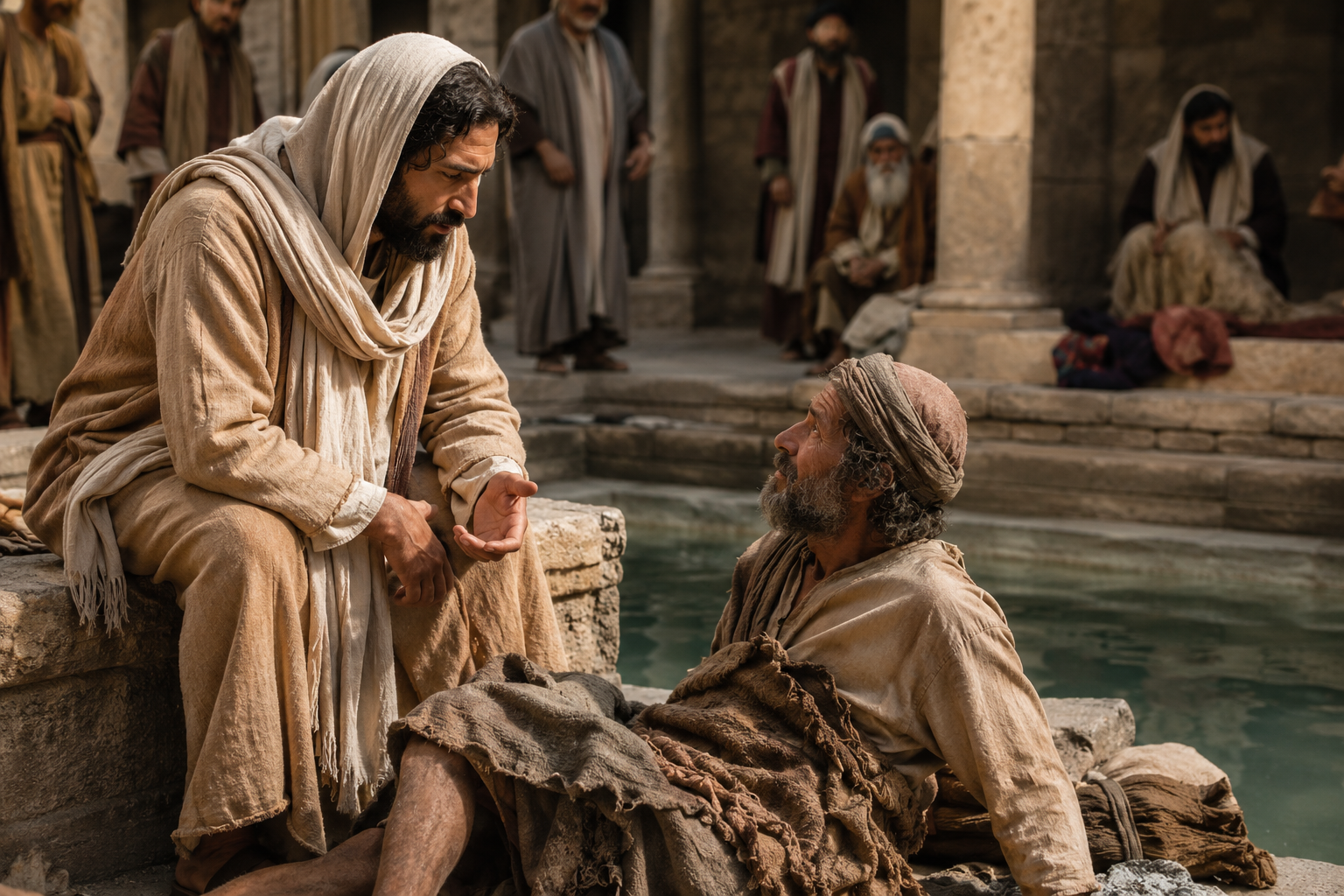
Last week, I was at church camp with eighty-four middle school and high school students. It was one of those full, exhausting, beautiful weeks filled with worship services, games, laughter, hard conversations, teenage emotions, very little sleep, and constant reminders of just how much young people are carrying.
While the students had other activities, the camp also offered a leadership track for those feeling called to ministry. I only made it to one of the classes, on the final day of camp, but apparently, that was the one I needed to attend.
The lesson was about emotional maturity and self-denial, two things that are deeply connected to following Jesus and leading people well.
One section of the lesson challenged us to look at the way Jesus led people. The handout said:
Stop forcing command-based choices and start asking growth-oriented questions that unlock self-discovery.
In other words, Jesus did not always begin by telling people what to think or demanding that they change their behavior.
Sometimes He asked a question.
Not because He did not know the answer, but because the person needed to recognize the answer within themselves.
The lesson gave three examples:
-
Matthew 16:13–15, when Jesus asked His disciples: "Who do you say I am?"
-
Luke 10:36, when Jesus asked, "Which of these three do you think was a neighbor?"
-
John 5:6, when Jesus asked a man who had been suffering for thirty-eight years, "Do you want to get well?"
That last question jumped out at me.
At first, Jesus' question almost sounds insensitive:
"Do you want to get well?"
The man has suffered for thirty-eight years. Why wouldn't he want healing?
But Jesus is not asking because He lacks information. The text specifically says Jesus saw him, knew his condition, and knew he had been that way for a long time. Jesus is asking because the man needs to hear, and reveal, his own answer.
First, what do we actually know about the man?
John 5:5 says:
"One who was there had been an invalid for thirty-eight years."
A few important distinctions:
-
The passage does not tell us how old he was.
-
It does not say he had been beside the pool for thirty-eight years.
-
It does not explain exactly what his disability was.
-
It does not technically call him paralyzed.
The Greek word describing his condition is astheneia, meaning weakness, sickness, frailty, or disability. Because Jesus later tells him to walk and carry his mat, his condition clearly affected his ability to move, but John does not give us a medical diagnosis.
So he had been afflicted for thirty-eight years, but we do not know how many of those years he had spent waiting at Bethesda.
And it was a pool, not exactly a well. It apparently had two sections with covered walkways around it and another walkway dividing the two sections, explaining John's unusual description of "five covered colonnades." Archaeological remains near Jerusalem's Sheep Gate fit that basic description.
The exact Greek words used in the question
John 5:6 reads:
Θέλεις ὑγιὴς γενέσθαι; Theleis hygiēs genesthai?
Word by word:
Theleis, θέλεις
This comes from thelō, meaning:
-
to want
-
to desire
-
to wish
-
to will
-
to choose or be willing
It is more than asking, "Would healing be pleasant?"
It carries the idea:
"Is this something you truly desire?" "Are you willing for this to happen?" "Do you want your condition to change?"
Hygiēs, ὑγιής
This means:
-
healthy
-
sound
-
well
-
whole
-
free from illness or defect
It is where we get the English word hygiene.
It can describe physical health, but it also carries the broader sense of something being sound or restored to proper condition.
Genesthai, γενέσθαι
This comes from ginomai, meaning:
-
to become
-
to come into being
-
to enter into a new condition
-
to experience a change of state
So Jesus did not merely ask:
"Would you like to feel better?"
A very literal rendering would be:
"Do you desire to become whole?"
Or:
"Are you willing to enter into a different condition than the one you have lived in?"
That wording matters. Jesus is not merely asking whether the man dislikes his suffering. He is asking whether he wants to become something different from what he has been for thirty-eight years.
Why ask such an obvious question?
Because wanting relief and wanting transformation are not always the same thing.
After thirty-eight years, the man's condition was not merely something happening to his body. It had shaped his whole life:
-
how he spent his days
-
where he lived
-
what he expected
-
what he believed was possible
-
how he related to other people
-
how he survived
-
how he understood himself
He may have wanted his pain removed while being unable to imagine an entirely different life.
Healing would mean more than stronger legs. It would mean:
-
getting up
-
carrying responsibility
-
leaving the community around the pool
-
finding a new way to live
-
no longer being known primarily by his condition
-
no longer waiting for someone else to rescue him
Jesus' question is not condescending. It is deeply dignifying.
Jesus does not treat him as an object upon whom a miracle will be performed. He addresses him as a person with a will.
"What do you want?"
Jesus does not begin by controlling the man, lecturing him, or announcing what He has decided to do. He asks a question that brings the man's inner world to the surface.
Does the man make excuses?
His answer is fascinating:
"Sir, I have no one to help me into the pool when the water is stirred. While I am trying to get in, someone else goes down ahead of me."
Notice what he does not say.
He does not say, "Yes."
But he also does not clearly say, "No."
He answers Jesus' question by explaining why his previous method has failed.
Jesus asks:
"Do you want to become well?"
The man hears something closer to:
"Why haven't you managed to get into the water?"
So he says:
"I don't have anybody." "I try." "Someone always beats me." "The system doesn't work for someone like me."
That can sound like excuse-making, but I would be careful not to judge him too harshly. Thirty-eight years of disappointment can train someone to explain obstacles before they express desire.
His answer shows at least three things.
1. He has connected healing to one method
He believes healing must come through:
-
the pool
-
the moving water
-
being first
-
having someone carry him
Jesus is standing directly in front of him, but the man is still talking about the pool.
That will preach.
Sometimes God asks us what we want, and we answer by explaining why the method we expected has not worked.
"I can't because nobody will help me." "I missed my chance." "Someone else always gets there first." "I don't have the resources." "I've already tried."
We may be so focused on how we thought God had to do it that we fail to recognize God standing in front of us.
2. He sees himself as dependent upon other people
His first statement is:
"I have no one."
That may be the deepest wound in his answer.
He does not simply have a physical limitation. He feels alone.
Maybe people had once helped him but stopped. Maybe he had family who abandoned him. Maybe nobody could stay long enough to wait for the water. We are not told.
But when Jesus asks about wellness, what comes out first is:
"Nobody is here for me."
Jesus' question uncovers the story underneath his condition.
And Jesus does not argue with that story. He becomes the One who is there.
3. He lives in a world of competition
His understanding of healing is:
"Only the first person gets it."
That means every other sick person around him is not simply a companion. They are competition.
The pool represents scarcity:
-
one opportunity
-
one winner
-
everyone else loses
But Jesus' power is not scarce.
Jesus does not need the man to be quickest, strongest, best-connected, or first.
The man's system says:
"Someone always gets ahead of me."
Jesus says, in effect:
"You do not have to beat anyone. I came directly to you."
Did an angel stir the water?
This is where Bible translations differ.
Some older translations include John 5:4, which says an angel periodically stirred the water and the first person entering was healed. Many newer translations either omit that sentence or place it in a footnote.
The reason is that the explanation about the angel does not appear in several of the earliest and strongest Greek manuscripts. Many scholars believe a later copyist added it to explain why the sick people waited there and why the man mentioned the water being stirred.
But notice: verse 7 is firmly part of the passage. The man himself clearly believed something significant happened when the water moved.
So we can confidently say:
-
The people believed the moving water offered healing.
-
The man believed he needed to enter it quickly.
-
We cannot be equally certain that John originally wrote the explanation about an angel.
-
John never tells us that Jesus confirmed the belief.
That last part may be important.
Jesus does not say:
"Yes, the angel is real; let Me help you win."
He completely bypasses the pool.
The pool might have represented superstition, a genuine local phenomenon, mineral or spring activity, a popular healing tradition, or some mixture of those ideas. But John's point is clear:
The water is not the healer. Jesus is.
Then Jesus gives him three commands
"Get up! Pick up your mat and walk."
The verbs matter because Jesus gives him something to do.
Get up
The Greek is egeire, from egeirō, rise, awaken, stand up. It is also frequently used elsewhere for resurrection.
This man has been lying down. Jesus commands him to rise.
Pick up your mat
The mat had carried him.
Now he must carry the mat.
That is a complete reversal.
The object that testified to his helplessness becomes evidence of his healing.
And perhaps Jesus tells him to carry it because He does not intend for the man to reserve his old place beside the pool.
He is not supposed to say:
"I'll leave the mat here just in case this healing doesn't last."
Jesus removes his backup plan.
Walk
Healing is not simply something the man receives while remaining where he was.
He must walk into it.
Jesus supplies the power, but the man responds through obedience.
This is where the man's answer becomes especially interesting. He did not give Jesus an impressive statement of faith. He did not demonstrate a perfect understanding. He apparently did not even know who Jesus was yet, verse 13 says he did not know who had healed him.
But when Jesus spoke, he got up.
So while verse 7 sounds like excuses, verse 9 shows there was still willingness inside him.
Perhaps the truest answer to "Do you want to get well?" was not what he said.
It was what he did next.
Jesus did not help him reach the pool
This may be my favorite detail.
The man says:
"I need someone to put me in."
Jesus does not become the helper the man requested.
He becomes the healer the man did not yet recognize.
Jesus could have said:
"I'll carry you closer." "Let's wait for the water together." "I'll make sure nobody gets ahead of you."
Instead He says:
"You don't need to get into that water. Get up."
The man asks, in effect, for assistance within his existing system.
Jesus gives him freedom from the system altogether.
Sometimes we ask God to help us manage the thing He intends to deliver us from.
But there is another layer later in the chapter
Jesus later finds him at the temple and says:
"See, you are well again. Stop sinning or something worse may happen to you."
That statement is serious, but we should not jump to the conclusion that every sickness is caused by personal sin. Jesus directly rejects that blanket assumption elsewhere, especially in John 9:1–3.
Still, John 5 suggests that Jesus was after more than the man's legs.
Jesus restored his body, then confronted his soul.
The word translated "well" in verse 14 is again hygiēs, the same "well/whole/sound" language from Jesus' original question.
It is almost as though Jesus says:
"You have become physically sound. Now do not return to a spiritually destructive life."
So "Do you want to become well?" may eventually encompass far more than:
"Do you want your body fixed?"
It may mean:
"Do you want your life restored?" "Do you want to leave behind what has held you?" "Do you want the responsibility that comes with freedom?" "Do you want more than temporary relief?" "Do you want to become whole?"
How this connects to leadership
Jesus often asks questions not because He needs answers, but because people need to discover what is inside them.
In Matthew 16, Jesus asks:
"Who do people say the Son of Man is?" "But what about you? Who do you say I am?"
He draws Peter toward personal ownership.
In Luke 10, Jesus asks:
"Which of these three do you think was a neighbor?"
He makes the religious expert reach the conclusion himself.
In John 5, He asks:
"Do you want to become well?"
He makes the man confront desire, disappointment, dependency, and willingness.
A command says:
"Here is what you need to do."
A growth-oriented question says:
"Tell me what you see. Tell me what you believe. Tell me what you truly want."
Jesus eventually does give a command: "Get up, pick up your mat, and walk."
But He asks the question first.
That order matters:
-
The question reveals the heart.
-
The command creates a decision.
-
Obedience produces movement.
Good leadership is not the absence of commands. Jesus gives direct commands all through Scripture.
But He does not merely force external behavior. He asks questions that expose the beliefs underneath the behavior.
The question for us
I think this passage invites us to sit with Jesus' question personally:
"Do you want to become whole?"
Not:
"Do you want the pain to stop?"
But:
"Are you willing for your life to change?"
Because sometimes becoming well means:
-
releasing the identity built around the wound
-
surrendering the excuse that has protected us
-
forgiving someone
-
accepting responsibility
-
leaving a familiar environment
-
allowing ourselves to hope again
-
obeying before we fully understand
-
picking up the mat instead of saving our old spot
And perhaps the hardest part:
We can become so accustomed to waiting beside our "pool" that waiting feels safer than walking.
Jesus' question is not cruel.
It is an invitation:
"You have told yourself why you cannot get there. But I am here now. Are you ready to rise?"